


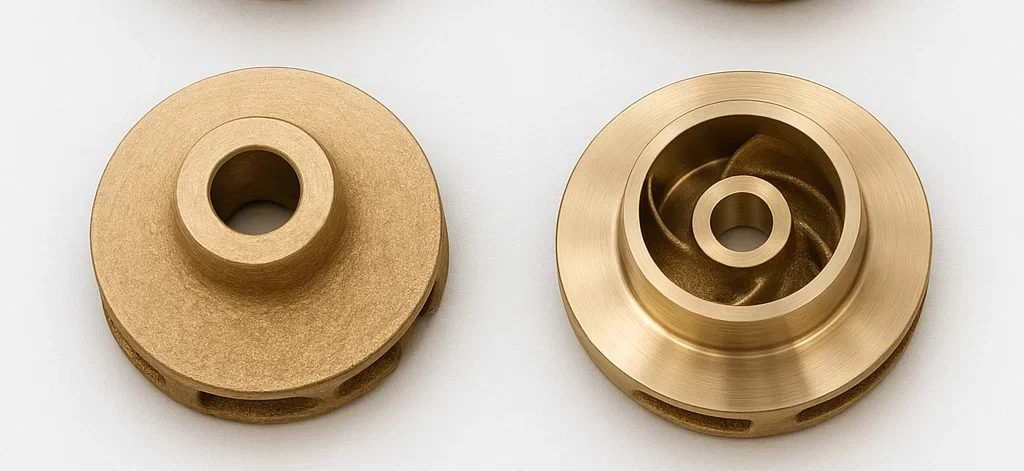
Bronze casting turns a copper alloy into a near-net-shape part that can be machined, tested and finished for its intended service. A pump casing, a heavily loaded bearing and a transformer connector can all be described as bronze castings. Their engineering requirements, however, can point to entirely different alloys and manufacturing processes. Start with the finished part’s job, identify the failure modes that matter, and then choose the alloy, casting route and inspection plan together.
This guide covers sand, shell, investment, permanent mold, die, centrifugal and continuous casting, along with specialized variants. It maps the main bronze alloy families and shows how to write a purchase specification for an industrial casting. For an overview of the supplier and product range, see our bronze casting foundry in India.

What is bronze casting?
Bronze is a commercial name for several families of copper alloys. Tin bronze is the classic copper-tin family. Aluminum bronze, nickel-aluminum bronze and silicon bronze take their names from different principal additions. Some historical trade names cross modern classification boundaries. Manganese bronze commonly describes a high-strength copper-zinc alloy, and some alloys sold as gunmetal or red bronze are grouped as red brass in the Unified Numbering System. The drawing should therefore give an exact material designation and product specification wherever a part has an engineering function.
The casting operation starts with a controlled charge of metal melted to the required chemistry. Liquid metal enters a mold, fills its cavities and solidifies. Feeders supply additional metal to compensate for contraction in regions that remain liquid late in solidification. After cooling, the foundry removes the mold or opens the die, removes gates and feeders, and cleans the casting. Heat treatment, machining, pressure testing, plating and final inspection follow where the job requires them. An as-cast blank and a finished machined casting can carry very different acceptance requirements even when they start from the same mold.
Ask which features need to be formed in the mold and which should be machined. A rough external contour can often follow the casting process capability. A sealing face, concentric bearing seat or threaded boss usually calls for dedicated machining and inspection. Separating these zones early helps avoid paying for a tighter tolerance over the entire component when only a few interfaces determine assembly fit.
Bronze casting processes at a glance
| Casting route | Typical reasons to evaluate it | Key design or purchasing checks |
|---|---|---|
| Green sand | Flexible near-net shapes, cored passages and repeat molding | Parting, draft, core shift, stock and molded surface expectations |
| No-bake sand | Larger castings, rigid molds or lower-volume tooling | Binder and gas control, handling, feeder layout and shakeout |
| Shell molding | Repeatable smaller and mid-sized parts with defined detail | Pattern tooling, shell strength, core support and economics at volume |
| Investment casting | Complex contours and fine detail where near-net shape saves work | Ceramic access, wax tooling, feedability and secondary operations |
| Gravity permanent mold | Repeatable openable shapes at sustained volume | Alloy and die compatibility, cooling, ejection and die life |
| Low-pressure or high-pressure die casting | Specialized repeat production with controlled filling or fast cycling | Specific alloy and equipment capability, porosity and tooling economics |
| Centrifugal casting | Rings, sleeves and other suitable rotational blanks | Inside machining allowance, acceptance zones and inspection method |
| Continuous casting | Bar, tube and constant-section stock for cut-and-machine parts | Stock form, dimensions, traceability and the finished part’s material specification |
Green sand and resin-bonded sand casting
Green sand molds use sand with a moist clay-based binder. The term describes the condition of the mold. A reusable pattern forms the cavity, and a separate core forms internal holes or channels when the geometry calls for them. Hand molding can serve development or lower volume. Mechanized squeeze or high-pressure molding can improve consistency and throughput on recurring jobs when the pattern, flask, sand controls and core-setting process are matched. High-pressure sand molding compacts sand around the pattern. The metal still fills the mold by its specified pouring method.
No-bake sand uses a chemically bonded mold that hardens without baking in an oven. It is useful where a rigid mold, heavy section or large pattern makes it attractive. Other sand variants include cold-box or hot-box coremaking, printed sand molds and cores, dry sand and vacuum molding. These labels describe different means of producing or holding the mold or core. Printed sand is particularly useful when an internal passage or development iteration would otherwise require a dedicated core box. Validate binder behavior, gas escape and handling on the real bronze grade before assuming results will transfer from another alloy or process.
Shell mold bronze casting
Shell molding uses a heated pattern to form a hardened layer of resin-coated sand. Paired shell halves can define the outside shape, and shell cores can also be used in suitable molds made by other methods. The stiff mold and repeatable pattern impression can help control detail on recurring components. The cost case is strongest when a series of identical blanks benefits from repeatability or reduced cleanup and machining. Evaluate the parting line, shell support, core seating and the effect of thin versus thick sections before setting drawing tolerances.
A threaded electrical body illustrates the trade-off. A shell core might establish a pilot cavity and reduce metal removal. The finished thread, the face against which the connector seats and the relationship between those features still need to be controlled after machining. A core shift study should use the actual blank and check that the minimum finished wall survives the worst credible offset.
Investment or lost-wax bronze casting
Investment casting builds a refractory shell around expendable wax patterns. The wax is removed, the shell is fired and the bronze is poured into the resulting cavity. The method suits details that are awkward to extract from a conventional pattern, along with contoured parts on which the amount of finish machining can be reduced. It can be used for functional parts and art bronze. The gating system, shell build, pouring practice and section transitions still determine how the casting fills and feeds.
Compare the real cost of wax tooling, shell processing, tree assembly, cut-off and inspection with the machining it eliminates. A thin feature that appears crisp on a CAD model can still be challenging to fill. An internal passage that cannot be cleaned reliably after casting may need a revised geometry or a different core strategy. Precision casting describes a process capability that must be demonstrated on the required geometry. Put the critical dimensions on the drawing and agree how each will be measured.
Permanent mold, gravity die and pressure-assisted casting
A permanent mold uses reusable tooling, commonly metal. In gravity die casting, liquid metal fills the die primarily under gravity. The heat extraction of a reusable metal die changes solidification behavior compared with a sand mold. Tooling, venting, coatings, preheat, cooling, ejection and any removable core must be designed as a system. For a suitable alloy and consistent annual release volume, shorter cycles and repeatable features can help offset higher tooling investment. ASTM B806 covers certain copper alloy permanent mold castings. Verify that the selected grade appears in the ordered edition.
Low-pressure casting uses a controlled pressure difference to move liquid metal into the mold. In a suitable system this can improve control of the fill path. High-pressure die casting injects metal into a die rapidly. Copper alloy temperatures and die wear make high-pressure work a specialized option. Aluminum die casting experience alone gives little evidence that a supplier can run the specific bronze grade. Squeeze casting applies pressure during solidification in specialized tooling. Counter-gravity or vacuum-assisted methods and vacuum investment processes also serve selected applications. Treat each as an engineering option subject to trials, attainable chemistry and demonstrated acceptance results.
Centrifugal bronze casting
Centrifugal casting rotates a mold while the metal is poured and solidifies. True centrifugal casting can produce an axisymmetric hollow blank such as a ring or sleeve without an internal core. A horizontal or vertical machine is selected to suit size, geometry and process needs. Semi-centrifugal casting and centrifuging use rotation for other shapes or multiple cavities, with different flow and feeding behavior. For a ring ordered as a machined part, describe the finished bore, outside diameter, datum surfaces and test locations.
The inner surface of a hollow centrifugal blank generally includes machining allowance. Segregation and material near the inner surface are considerations when choosing stock dimensions and acceptance zones. A drawing should distinguish the surface as delivered from the surface after machining, particularly where a bearing layer, bore or seal seat is critical. ASTM B271/B271M is a common specification to check for centrifugal copper alloy castings.
Continuous cast bronze bar, tube and profiles
Continuous casting feeds liquid bronze into a cooled die and withdraws the solidifying product as a length of stock. Bars, hollow bars and suitable constant-section profiles can be cut to length and machined. This route is useful for bushings, wear strips and parts that can be produced economically from a repeatable section. ASTM B505/B505M is a reference for copper alloy continuous castings. Identify the exact grade, stock form and sizes and state the applicable product requirements before asking for a cut-and-machine quote.
A comparison between a sand-cast bushing and one machined from hollow bar should include metal yield and machine time as well as the cost of each blank. Solid round stock can be a reasonable choice where the bore is small or quantities are modest. Hollow stock may cut boring time and scrap when the available size aligns with the finished wall. A near-net shaped sand casting may win for a flanged body with widely differing sections.
Bronze casting grades and alloy families
The Copper Development Association maintains a UNS copper alloy reference. The formal cast bronze series is C90000–C95999, with assigned grades within that range. The cast bronze registry lists individual chemistry limits, notes and active or inactive designations. Silicon bronze and alloys commercially called manganese bronze or red bronze can appear in the cast brass series. Availability, process coverage and specified properties should be checked grade by grade. The examples below are starting points for material selection rather than an offer to supply every registered alloy.
| Family | Examples and related designations | Selection considerations |
|---|---|---|
| Tin bronze and high-tin bronze | C90300, C90500, C90700, C90710, C90800, C90810, C90900, C91000, C91100, C91300 | Wear, gear or bearing service and corrosion performance depend on exact chemistry, section and route |
| Nickel-bearing tin bronze | C91600, C91700 | Review load, wear pair, lubrication and casting specification |
| Leaded tin bronze | C92200, C92300, C92400, C92500, C92600, C92700, C92800, C92900 | Machinability and sliding service can be useful where lead is permitted |
| High-leaded tin and bearing bronzes | C93100, C93200, C93400, C93500, C93600, C93700, C93800, C93900, C94000, C94100, C94200, C94300, C94400, C94500 | Assess bearing loads, lubrication and legal or customer lead limits |
| Aluminum bronze | C95200, C95300, C95400, C95410, C95420, C95430, C95600, C95700, C95900 | Check exact iron or nickel content, heat treatment, machinability and environmental exposure |
| Nickel-aluminum bronze | C95500, C95510, C95520, C95800, C95810, C95815, C95820 | Compare microstructure, strength and corrosion test requirements for the actual service |
| Cast silicon bronze and related copper-silicon alloys | C87300 and C87600, plus silicon-brass grades such as C87850 where appropriate | Confirm the specific classification, conductivity and approval status before substitution |
| Commercially related red brasses and gunmetals | C83300, C83600, C84400; EN 1982 examples CC490K, CC491K and CC493K | Check lead content and pressure or water-contact qualification for the finished article |
| High-strength yellow brass sold as manganese bronze | C86200, C86300, C86500 | Consider strength, wear and corrosion in the actual environment, especially where zinc-bearing alloys are restricted |
| Reduced-lead or no-intentionally-added-lead options | Grade-specific silicon or bismuth alternatives, including cast copper alloys C87500, C87850, C89540 and C89550 for review | Evaluate exact lead limits, process, part approval and any required finished-product certification |
Cast bronze UNS grade index
Use this index to identify assigned grades shown in the cast bronze registry, including legacy entries. The registry gives current designation status, chemistry and restrictions. Grade registration alone does not establish availability or approval for a particular part.
- C90200, C90250, C90280, C90300, C90400, C90410, C90420, C90430, C90500, C90700, C90710, C90800, C90810, C90900
- C91000, C91100, C91300, C91500, C91600, C91700
- C92200, C92210, C92220, C92300, C92310, C92400, C92410, C92500, C92600, C92610, C92700, C92710, C92800, C92810, C92900
- C93100, C93200, C93400, C93500, C93600, C93700, C93720, C93800, C93900
- C94000, C94100, C94200, C94300, C94310, C94320, C94330, C94400, C94500, C94700, C94800, C94900
- C95200, C95210, C95220, C95300, C95400, C95410, C95420, C95430, C95500, C95510, C95520, C95600, C95700, C95710, C95720, C95800, C95810, C95815, C95820, C95900
Tin bronze, phosphor bronze and bearing bronze
Tin bronzes such as C90300 and C90500 can be evaluated for wear and bearing duty. C90700 is familiar in industrial gear and bearing discussions. Higher-tin grades such as C91100 and C91300 merit an independent review of hardness, toughness and manufacturability. Even when a supplier uses the phrase cast phosphor bronze, look up the specified phosphorus range and the remaining composition. Wrought phosphor bronze strip or rod is a different product form, with its own UNS designation and properties. Terms such as SAE 65 or SAE 660 may help identify an older drawing, but the purchase specification should capture the precise present-day grade and route.
C93200, often called SAE 660 bearing bronze, is a familiar leaded choice for general sliding applications. Compare it with grades such as C93700 or C95400 only against the real load, speed, lubrication, allowable temperature and shaft condition. A replacement that increases hardness can change wear on the mating shaft or move damage to a more expensive assembly. Review running clearance after assembly and at temperature. Where environmental or product requirements restrict lead, agree on an approved alternative and run the relevant wear or service validation.
Aluminum bronze and nickel-aluminum bronze
C95200, C95300 and C95400 are examples of cast aluminum bronze. Aluminum bronzes can be candidates for high-load wear parts, pump components, industrial hardware and selected electrical connector bodies where the joint design and testing support the alloy. Nickel-containing grades such as C95500 and C95800 deserve their own review. The nickel, aluminum and iron balances influence microstructure and properties, and the required heat treatment or casting specification can differ. Specify the cast and heat-treated condition, sampling method and any mechanical or microstructural criteria rather than relying on a family name.
For pump and marine service, identify the medium, temperature, flow, exposure to seawater or chemicals, aeration and the adjacent metals. Consider cavitation, galvanic coupling, crevices and sand or other solids. A seawater impeller and a pump pressure casing can need separate acceptance tests. An impeller may need balance and dimensional verification of vane geometry, while a casing may need hydrostatic testing and controlled machining around seals. See our related guide to bronze pump impellers and pump components.
Silicon bronze, gunmetal and lead-restricted grades
Cast silicon bronze such as C87300 and related copper-silicon casting alloys are useful candidates for selected industrial, architectural and hardware applications. Compare grades individually for castability, chemical composition, conductivity and machinability. The term gunmetal commonly points to copper-tin-zinc casting alloys, sometimes with lead. It is an especially poor substitute for a grade number because historic and regional names vary. C83600 and CC491K are familiar discussion points, but apparent compositional similarity alone does not authorize a change.
For potable water or any application with a lead limit, specify the exact rule that applies to the finished product and its intended market. Ask for the chemistry report and any approval or certification required for that part and use. A chemistry statement on the metal is one piece of evidence. Exposure limits, surface-area calculations or extraction tests, where relevant, are separate requirements. Keep lead-containing heats and restricted heats separately identified so later processing preserves traceability.
ASTM, EN and legacy bronze designations
For North American drawings, pair the UNS grade with the applicable ASTM product standard and edition. ASTM B584 covers specified general-purpose copper alloy sand castings. B148 covers aluminum bronze sand castings within its scope. B271/B271M and B505/B505M address centrifugal and continuous castings respectively, and B806 addresses specified permanent mold copper alloy castings. A grade may appear in several specifications, with different process, mechanical property or sampling provisions. Consult the ordered edition and the grade listing, such as the C95400 alloy reference, before carrying material requirements across product forms.
EN 1982 uses its own ingot and casting designations. Examples include CC480K and CC483K for tin bronzes, CC491K and CC493K for gunmetal families, and CC331G, CC332G and CC333G for aluminum bronze families. Suffixes and cast condition need to follow the applicable documentation. An EN-to-UNS comparison is a shortlist for engineering review. It should account for full chemistry limits, process, mechanical properties, test coupon type, heat treatment and any purchaser additions. Ask the drawing owner to approve the exact substitution in writing before production. The Copper Information Center’s EN 1982 overview provides an entry point to the European designations.
Design for soundness, machining and repeat production
Start the review by marking critical finished surfaces and minimum finished walls on the model. Large intersections of ribs, pads and bosses can become hot spots. A more gradual section transition and appropriate fillets can assist solidification and reduce stress concentration. Agree on draft, parting line, gate and feeder locations and witness marks. A feeder scar is easier to remove from a designated nonfunctional surface than from a cosmetic face or the root of a load-bearing feature. Use realistic foundry tolerances for the raw shape and tighter machining tolerances for the functional interfaces.
Plan how the blank will locate in its first machining fixture and how datums carry through later operations. A broad, stable locating face can make the finished bore position more repeatable. If a casting skin is retained in the final part, agree on visual standards, acceptable flash and any limits on grinding. If porosity opens during machining, the acceptance rule should address the exposed location and function. A defect near a pressure boundary or a tapped load-bearing hole has different consequences from a similar surface indication on a noncritical rib.
Control chemistry with traceable heats and a validated method such as optical emission spectroscopy where appropriate. Mechanical test specimens may be separately cast, cast-on or taken from a finished part, according to the standard and agreement. Those approaches can represent different cooling histories. When material performance in a critical section matters, state the sampling location and acceptance criteria. Typical values in an alloy reference help with material screening. Contract minima and lot acceptance belong in the approved specification.
Inspection can combine visual examination, dimensional layouts, hardness testing, chemistry, and targeted nondestructive examination. Liquid penetrant can reveal surface-breaking indications on appropriate surfaces. Radiography can assess internal discontinuities where material, thickness and access allow. A pressure test answers a leakage question under defined conditions. State the test method, location, sampling, standard, pressure or other limits, and who reviews the results. Repair welding and impregnation require purchaser approval where specified, especially if the repair affects pressure, corrosion, electrical contact or a regulated application.
How to compare bronze casting quotations
Send a controlled drawing revision, a STEP model when available, the required quantity and annual forecast, plus a description of service. Specify the alloy, product standard and edition, cast route if fixed, heat treatment, tolerances, machined surfaces and finishing. Flag pressure or wear zones, special packaging, material certification and any first-article or production approval needs. State whether tooling is customer-owned, how it will be maintained and which changes require notification.
Review quotations on the same delivery basis. A price for a cleaned blank differs from one for a fully machined, inspected and finished casting. Ask how each supplier estimates tooling, melt and metal yield, machining fixtures, test samples, scrap and delivery. When a prototype uses a route different from production, define the tests that must be repeated after the production tooling and process are released. Agree how to identify heats and lots through machining and outside finishing, and specify the evidence needed with each shipment.
Bronze casting questions and answers
Which bronze casting process is best for a pump housing?
Sand casting is often a useful starting point for cored pump housings because it accommodates internal flow passages and different envelope sizes. Review shell or permanent mold when geometry and order volume support them. Specify the fluid, operating conditions, pressure test and machined sealing areas. Agree on how internal passages are cleaned and checked.
How do I choose between C93200 and C95400?
Start with the approved operating conditions, bearing geometry and shaft surface. C93200 is a leaded bearing bronze with a long history in sliding applications. C95400 is an aluminum bronze chosen for a different combination of properties. Check running clearance, lubrication and the failure history, then qualify the chosen material and route for that application.
Can all bronze alloys be cast in every mold type?
Each route has a practical window governed by chemistry, temperature, geometry, tooling and the required properties. Verify that the alloy is included in the relevant casting specification and supported by production trials for the part. A designation alone gives the chemistry identity. It does not specify which equipment or process can meet the drawing.
When should a bronze part be machined from continuous cast stock?
Consider it when the shape fits available solid or hollow stock and machining can produce the required features with reasonable yield. Compare purchased weight, cutting time and quality requirements against the total cost of a near-net casting. A complicated external contour or multiple intersecting cavities can favor molding.
Can the same bronze grade give different properties in two castings?
Yes. Section thickness, cooling rate, heat treatment and specimen location can affect measured results. Specify the route, condition and required properties for the purchased casting. For an especially important zone, discuss sampling or direct examination of that zone with the supplier.
What should a bronze casting material certificate include?
Request the purchase and drawing references, alloy and product standard, heat or lot identity and measured chemistry. Add mechanical, hardness, heat-treatment and nondestructive inspection records as required by the order. Agree on what is reported separately and how the certificate links to physical lot identification.
How do I specify a lead-restricted bronze casting?
Identify the applicable rule or customer restriction and the exact finished product use. Approve a grade and a process with traceable material records. Where the product requires certification or testing beyond chemistry, include that in the quotation and approval package.
Request a quotation for custom bronze castings
Send your drawing, target bronze grade, casting weight, annual volume and acceptance requirements to Brass Neutral Links India. Include the finished dimensions, service environment, mating components and any applicable ASTM or EN requirements. We can discuss the practical casting and machining route, tooling assumptions and the inspection package for your project. Request a bronze casting quotation or email info@brass-neutral-links.com.
